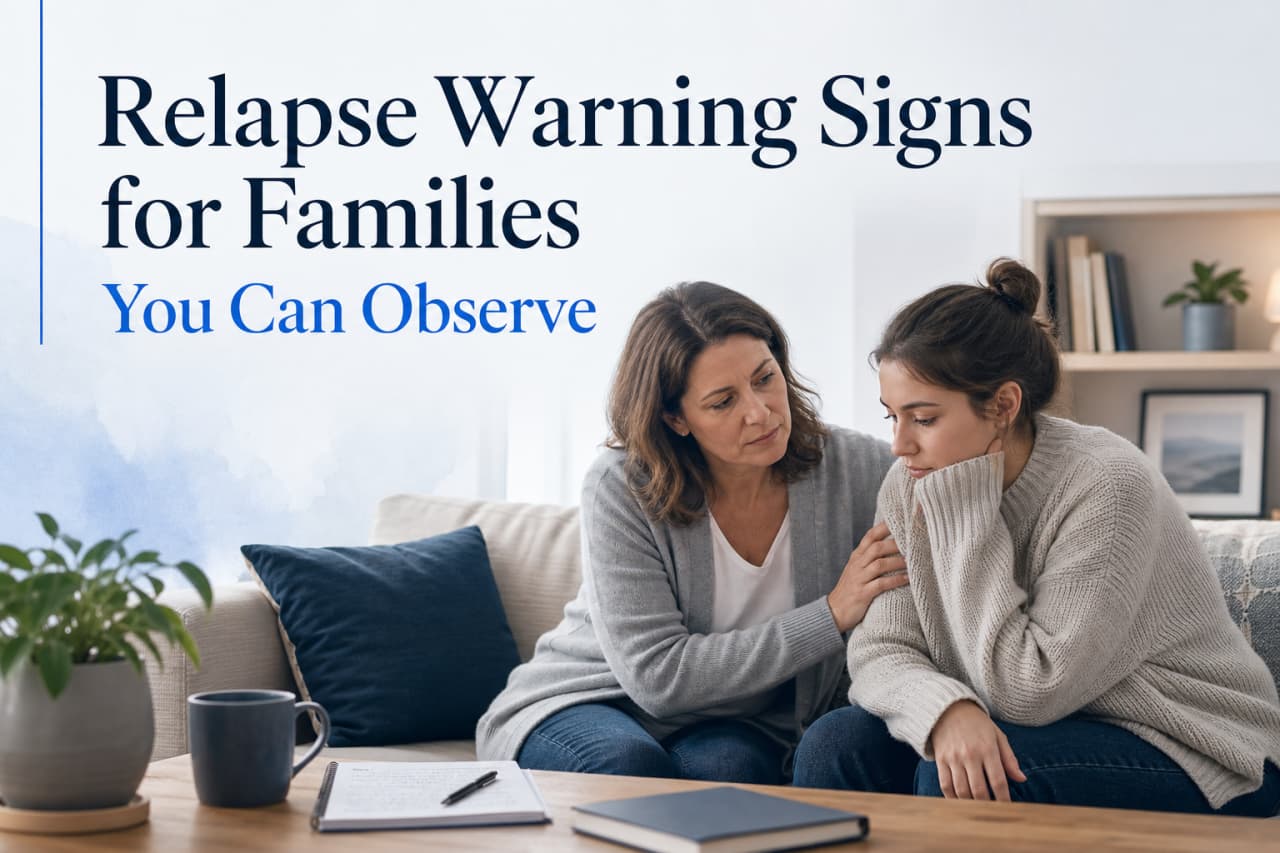
Your loved one can change. You cannot make recovery happen for them. Realistic hope for the family of an addict means supporting treatment, watching behavior rather than promises, setting boundaries you can keep, and getting care for yourself. Denial asks you to ignore evidence. Hope helps you respond to it.
What does realistic hope for the family of an addict mean?
Realistic hope holds two facts at the same time. Recovery is possible. Your loved one remains responsible for choosing recovery actions. You can offer support, share treatment options, protect your home, and speak honestly. You cannot attend appointments, follow a recovery plan, or stop substance use for another person.
The National Institute on Drug Abuse describes addiction as a chronic disease involving changes in the brain. That framing can lower blame. It does not require you to accept unsafe conduct. Compassion and accountability can sit in the same conversation.
Our Intensive Family Program gives families a factual base for those talks. Its 12 modules cover the definition of addiction, the central nervous system, codependency, difficult conversations, gaslighting, and the transition home after treatment. Two worksheets help you build a Relapse Prevention Plan and a Family Support Plan.
Facts protect hope.
How can you tell hope from denial?
Watch what each one asks you to do. Hope asks you to face current behavior and choose a response within your control. Denial asks you to explain away repeated harm, accept promises without action, or hide the situation from people who could help.
A missed appointment is a missed appointment, even when the explanation sounds believable. Money that disappears is still missing. An unsafe drive remains unsafe. You do not need to decide whether your loved one meant harm before protecting yourself or other family members.
Start with what you know firsthand. Separate observed facts from guesses, fears, and secondhand reports. Look for actions that support recovery, such as attending care, following a treatment plan, or speaking honestly after a setback. Name your own responsibility next. That may mean protecting household money, arranging care for children, or declining to cover up substance use. Then choose a boundary you can carry out. Skip threats that depend on controlling another person's behavior.
Our Fix Your Family program practices this distinction through communication, boundary-setting, and conflict resolution. The live online session meets every Monday at 7:00 PM CT and 5:00 PM PT. Families can bring real situations into a structured setting led by Beth Durling, MS, CADCII, ICADC.
What should you support, and what should you stop carrying?
Support the recovery work your loved one chooses. Leave their recovery responsibilities with them. You might share treatment information, provide transportation when it is safe, or take part in a family session. Calling an employer with a false story, automatically paying new debts, or monitoring every movement puts you inside work that belongs to someone else.
Boundaries describe your actions. A clear boundary has a simple shape. “If this happens, I will take this step.” You might say, “I won't ride with you if I believe you are impaired,” or “I won't provide cash, but I can help you contact a treatment provider.” Choose limits that fit your household, safety needs, and finances.
Abrupt changes can carry legal, financial, or safety risks. Get qualified guidance before changing housing, access to children, shared accounts, or medical arrangements. Our 1-on-1 family coaching is available by appointment with a certified counselor who can help you build a family-specific recovery plan.
Cost may limit the options open to your family. The Family Recovery Foundation offers application-based financial aid for residential, outpatient, and detox programs based on clinical needs. We also provide funding guidance for professional intervention services when a loved one has not accepted treatment.
How do you respond when promises and behavior disagree?
Set a date or event for reviewing observable actions. A review point might follow the next treatment appointment, family meeting, or agreed household responsibility. Open-ended promises keep families waiting without new information. A defined review point gives you facts for the next decision.
A return to substance use does not erase every recovery action that came before it. It does call for a fresh safety check, contact with qualified treatment providers, and a review of your boundaries. Avoid large decisions based only on an apology or a single hard day.
The Courage to Detach focuses on loving without enabling, setting boundaries with compassion, and protecting your wellbeing. This virtual workshop meets on the last Wednesday of each month at 5:00 PM CT and 3:00 PM PT.
Hope needs a calendar.
What can you do if your loved one refuses help?
You can change your own participation even when your loved one declines treatment. Keep your message brief and consistent. You could say, “I care about you. I will help you contact treatment when you are ready. I won't provide money or hide substance use from other people affected by it.”
Treatment information should come from qualified sources. The SAMHSA treatment locator can help families search for substance use and mental health care. The Family Recovery Foundation can provide treatment financial aid information and guidance about professional intervention services.



Your support does not have to wait for your loved one's decision. The Family Room meets every Friday at 10:00 AM CT and 8:00 AM PT. Its open format lets family members share experiences and ask questions. Registered families can also use our private messaging group for 24/7 access to the Clinical Director and trained peer support team.
The Family Recovery Foundation provides ongoing family support rather than emergency care. Call 911 if someone is in immediate danger. Call or text the [988 Suicide & Crisis Lifeline](https://988lifeline.org/) for a suicide, mental health, or substance use crisis.
Where can your family get free support?
Start with a live program you can attend consistently. The Family Recovery Foundation offers free virtual family therapy and live online family support nationwide. No insurance is required for free programs.
| Program | Schedule | What it covers |
|---|---|---|
| Fix Your Family | Mondays at 7:00 PM CT / 5:00 PM PT | Communication, boundaries, conflict resolution, and rebuilding trust |
| The Family Room | Fridays at 10:00 AM CT / 8:00 AM PT | Open family support, shared experience, questions, and peer guidance |
| Morning Meditation | Monday through Friday at 9:00 AM CT / 7:00 AM PT | A 15-minute guided mindfulness practice for emotional regulation |
| The Courage to Detach | Last Wednesday of each month at 5:00 PM CT / 3:00 PM PT | Healthy detachment, compassionate boundaries, and personal wellbeing |
| 1-on-1 Family Coaching | By appointment | A family-specific recovery plan developed with a certified counselor |
| Private Family Messaging Group | Available 24/7 | Messaging access to the Clinical Director and trained peer support team |
Our free virtual family therapy hub explains the available programs and registration process. The online meetings page lists live sessions, while the About The Family Recovery Foundation page explains our nonprofit mission, clinical facilitation, and Christian faith-based orientation.
Pick one steady source of support. You do not need to solve the entire family situation before attending your first session.
Frequently Asked Questions
A real person answers 888-964-8825 every day. These answers can also help you decide which free program fits your current situation.
Can I stay hopeful after my loved one returns to substance use?
Yes. Focus first on immediate safety, contact with qualified treatment providers, and the boundaries you can carry out. Our downloadable Relapse Prevention Plan can help families identify warning signs and planned responses without treating one recurrence as proof that future recovery is impossible.
Does setting boundaries mean I am giving up?
Boundaries keep your actions clear while your loved one makes their own choices. Modules 7 and 8 of our Intensive Family Program cover personal boundaries and the language of connective boundaries. A useful limit protects safety or wellbeing and names what you will do.
Can I join if my loved one is still using substances?
Yes. The programs support families while a loved one is using substances, entering treatment, or returning home. Module 10 focuses specifically on the transition home after treatment, while live sessions address current family concerns.
Do I need insurance for virtual family therapy?
No insurance is required for The Family Recovery Foundation's free virtual family therapy and online family support programs. Registration is available nationwide.
Is The Family Recovery Foundation a treatment center or detox?
The Family Recovery Foundation is a 501(c)(3) nonprofit providing family therapy, education, coaching, support groups, and financial aid. Residential treatment, detox, and emergency response fall outside our services. We are also separate from the Ohio organization called Family Recovery Center.
What should I do during a mental health or substance use emergency?
Call 911 when someone is in immediate danger. Call or text 988 for crisis support related to suicide, mental health, or substance use. Our team can provide ongoing family support after the immediate emergency has been addressed.
Get free virtual family therapy
Register for free nationwide online family therapy and support programs. No insurance required.
Choose Get Help to register, or call 888-964-8825. A real person answers every day.
About the Author
The Family Recovery Foundation
Editorial TeamEducational and program resources from The Family Recovery Foundation (EIN 87-4108362) — free virtual family therapy and support for families impacted by addiction and mental health. Charity Navigator: charitynavigator.org/ein/874108362.