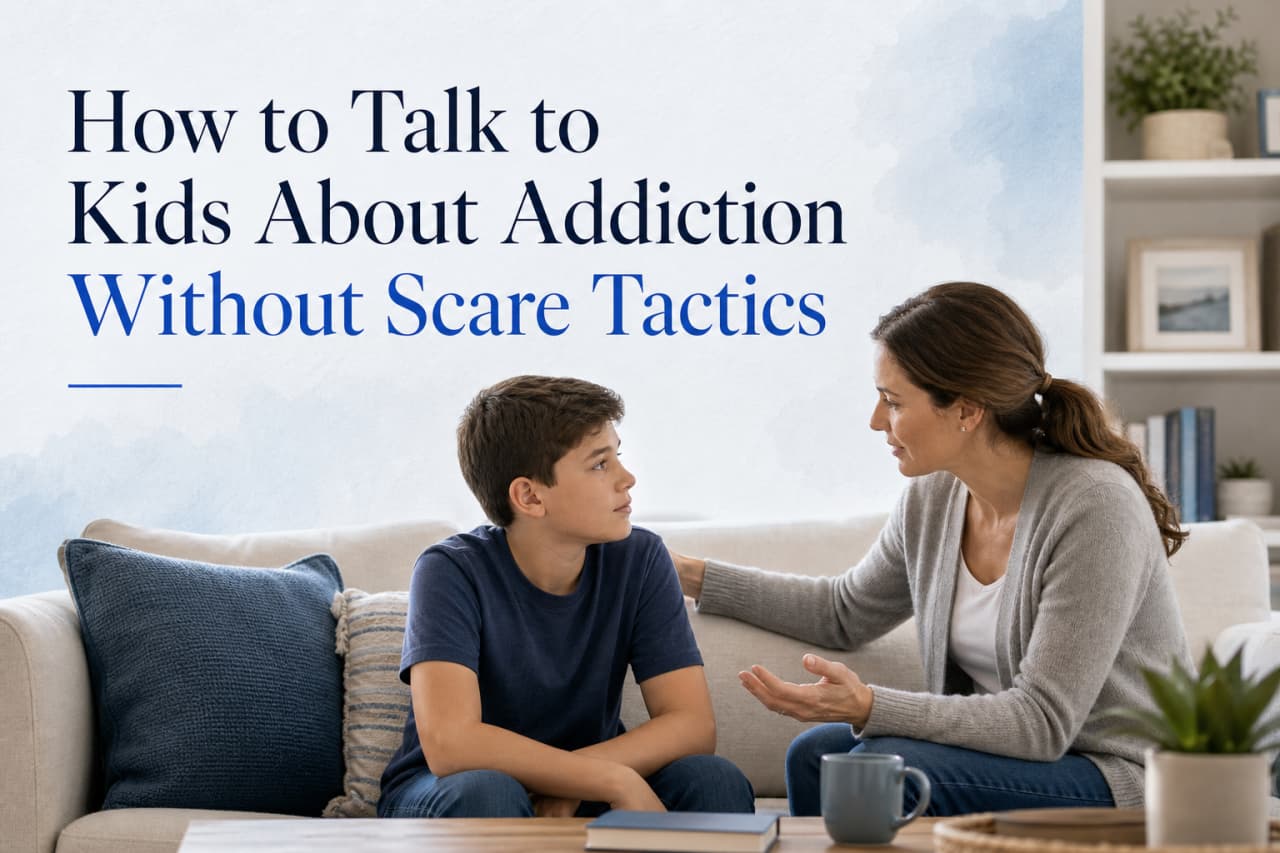
A missed school pickup or sudden argument can tell a child that something has changed before any adult explains why. If you’re deciding how to talk to kids about addiction, keep the words short and true. Name what is not the child’s fault. Leave room for questions. Skip threats and graphic stories.
Why should you skip scare tactics?
Scare tactics swap usable information for frightening predictions. Graphic overdose stories, threats of prison, and claims that one choice always ends in the worst outcome pull a child’s attention toward fear instead of the question they actually asked.
Give the smallest truthful answer that fits the child’s age. Then pause. A child who wants more detail will usually ask again. A child who has heard enough may go back to playing or change the subject.
The SAMHSA Talk. They Hear You. campaign encourages parents to start conversations early and keep them going over time. You do not need one perfect speech. Short talks during ordinary moments leave space for correction, questions, and new facts.
Family education programs at The Family Recovery Foundation cover how addiction works, how the central nervous system responds, and how families set communication and boundaries. Those topics help you decide what belongs in a talk with your child and what should stay between adults.
Tell the truth at the child’s size.
How to talk to kids about addiction at each age
Use the youngest language that still answers your child’s real question. The age ranges below are starting points, not tests. Maturity, prior knowledge, and direct exposure to substance use should guide how much detail you give.
Describe what you know. If no qualified clinician has diagnosed a substance use disorder, explain the behavior you have seen rather than assigning a diagnosis yourself.
| Age | What to explain | Age-appropriate script |
|---|---|---|
| Ages 4–6 | Focus on what is happening now, who is caring for the child, and what the child should do next. | “Dad has been drinking alcohol, and it is changing how he acts. You didn’t cause this. Stay with me, and I’ll tell you what happens next.” |
| Ages 7–9 | Give a simple definition of addiction. Explain that adults handle treatment and safety. | “Addiction means a person’s brain and body can get stuck wanting alcohol or drugs even when those substances cause harm. Grown-ups are responsible for finding help. You’re responsible for being a kid.” |
| Ages 10–12 | Name substance use disorder as a health condition. Explain that the condition may affect judgment without excusing harmful behavior. | “A substance use disorder can make stopping very hard. Treatment and ongoing support may help. The condition explains part of what is happening, but our family safety rules still apply.” |
| Ages 13–17 | Use direct facts about the substance, observed behavior, treatment plans, boundaries, and where the teen can ask for help. | “I’ll answer your questions directly. Alcohol has affected Mom’s decisions and our family. She is responsible for her treatment. You can care about her without monitoring or fixing her recovery.” |
If your child asks why a loved one can’t simply stop, explain the mechanism without giving a lecture. The National Institute on Drug Abuse explains that repeated drug use can change brain circuits connected to reward, stress, and self-control.
You might say, “The brain can learn to push a person toward the substance even when using it causes serious problems. Stopping may require treatment and continued support. The person remains responsible for following safety rules.”
Free virtual family therapy and family education at The Family Recovery Foundation give parents material they can use before and after these talks. Programs run online nationwide, so your family can join from home.
How do you explain a loved one’s behavior without excusing it?
Separate what happened, why it may have happened, and what your family will do next. That structure gives the child context while keeping responsibility with the adults.
During current substance use, you might say, “Your aunt’s speech and decisions changed after she used a drug. We are leaving because the situation is unsafe. You didn’t cause her behavior.”
During treatment, try, “Dad is receiving treatment for a substance use disorder. Treatment is work he has to do. You may love him and still feel angry, worried, or confused.”
If a loved one returns to use, say, “Mom returned to alcohol use. The adults are changing the support plan. You didn’t cause this, and you can’t fix it.” Do not ask the child to watch the person, report every behavior, or calm the adults down.
Keep privacy separate from dangerous secrecy. Privacy limits who receives personal medical details. A dangerous secret stops a child from asking for help when they feel frightened or see unsafe behavior.
A useful script is, “This is personal family health information, so we won’t share every detail with everyone. You may always talk to me, your counselor, or another trusted adult. You never have to keep a secret about danger.”
Fix Your Family, our free weekly online session, teaches communication, boundary-setting, and conflict resolution. Parents can use those skills to prepare for hard conversations instead of speaking in the middle of an argument.
A diagnosis never cancels a boundary.
What family safety rules should children hear?
Children need clear actions they can remember under stress. Keep each rule short. Practice it when the household is calm. Update the plan as the child gets older.
Never ride with someone who has been using alcohol or drugs or who seems impaired. Call the designated trusted adult instead. Do not touch unknown pills, powders, drug supplies, or unattended drinks. Move away and tell an adult. Leave the room and contact a trusted adult if shouting, threats, impaired driving, or unsafe substance use begins. Call 911 if someone will not wake up, is not breathing normally, or is in immediate physical danger.


Write down the names and phone numbers of adults your child may contact. Include one person outside the household when you can. Make sure the child knows the address where they live. Do not assign them the job of monitoring a loved one’s condition.
The Family Recovery Foundation offers a downloadable Family Support Plan worksheet through our education resources. Completing it with another trusted adult can help you decide who handles transportation, emergency calls, childcare, and updates to the child.
The Family Recovery Foundation provides ongoing family support and does not operate a crisis hotline. Call or text [988 through the SAMHSA 988 Suicide & Crisis Lifeline](https://www.samhsa.gov/find-help/988) for a suicide, mental health, or substance use crisis. Call [911](https://www.911.gov/) for an immediate physical emergency.
How can you keep the conversation open?
Return to the topic after meaningful changes. Treatment entry, a move, a return home, a new boundary, or another episode of substance use may create new questions even if your child said little the first time.
Ask, “What have you noticed?” Then listen before correcting details. Follow with, “What are you worried might happen?” and “What do you want to know?” Those prompts give you clearer information than asking whether the child is okay.
Admit what you don’t know. You can say, “I don’t know the answer yet. I’ll ask a qualified professional and come back to you.” Keep that promise. If the situation changes, tell the child before they hear a confusing version from someone else.
A child may decline to talk. Leave the invitation open without forcing disclosure. If your child reports danger, blames themselves, asks for professional help, or says they might hurt themselves or someone else, take the statement seriously and involve an appropriate clinician or emergency service.
You can practice these conversations through free virtual family therapy, online family support groups, 1-on-1 family coaching, and family education programs. Live sessions such as Fix Your Family, The Family Room, Morning Meditation, and The Courage to Detach give families regular places to build the same skills.
Questions Readers Ask
Nationwide online family programs give parents a place to discuss questions like these with experienced facilitators and certified counselors. No insurance is required for free programs.
What should I say if my child asks whether our loved one will die?
Tell the truth without predicting an outcome. Say, “Substance use can seriously hurt a person’s body, and I can’t promise what will happen. The adults are working on safety. If there is an emergency, I’ll explain what we are doing.” Only say adults are taking action when that is true.
How should I answer if my child asks whether the person chose addiction?
Explain that people begin using substances for different reasons and that a substance use disorder can make control much harder. Try, “Your loved one is responsible for accepting help and following safety rules. Their condition does not mean you caused their choices.”
Should I tell my child’s school?
Tell an appropriate school professional when family changes could affect pickup plans, attendance, safety, or your child’s ability to participate in class. Share only the information needed to support the child. Ask how the school handles privacy before giving medical details.
What if my child tells other people about the addiction?
Do not punish a child for seeking support. Explain which details are private and name trusted people they may speak with. Say, “You may talk about your feelings and ask for help. We will keep someone else’s medical details within a smaller group.”
What if I have a history of substance use?
Share truthful details that serve the child’s question and age. Avoid graphic stories or descriptions that make risky behavior sound exciting. You might say, “I used substances in ways that hurt my health and our family. I’m responsible for my recovery, and you may ask me honest questions.”
Can siblings receive different explanations?
Yes. A teenager can receive details that would confuse a five-year-old. Keep the core facts consistent across the family, including what happened, what the safety rules are, and who is responsible for treatment. Tell older siblings they are not responsible for explaining addiction to younger children.
Get free virtual family therapy
Register for free nationwide online family therapy and support programs. No insurance required.
Choose Get Help to register, or call The Family Recovery Foundation at 888-964-8825. A real person answers every day and can help you identify the family program that fits your current situation.
About the Author
The Family Recovery Foundation
Editorial TeamEducational and program resources from The Family Recovery Foundation (EIN 87-4108362) — free virtual family therapy and support for families impacted by addiction and mental health. Charity Navigator: charitynavigator.org/ein/874108362.