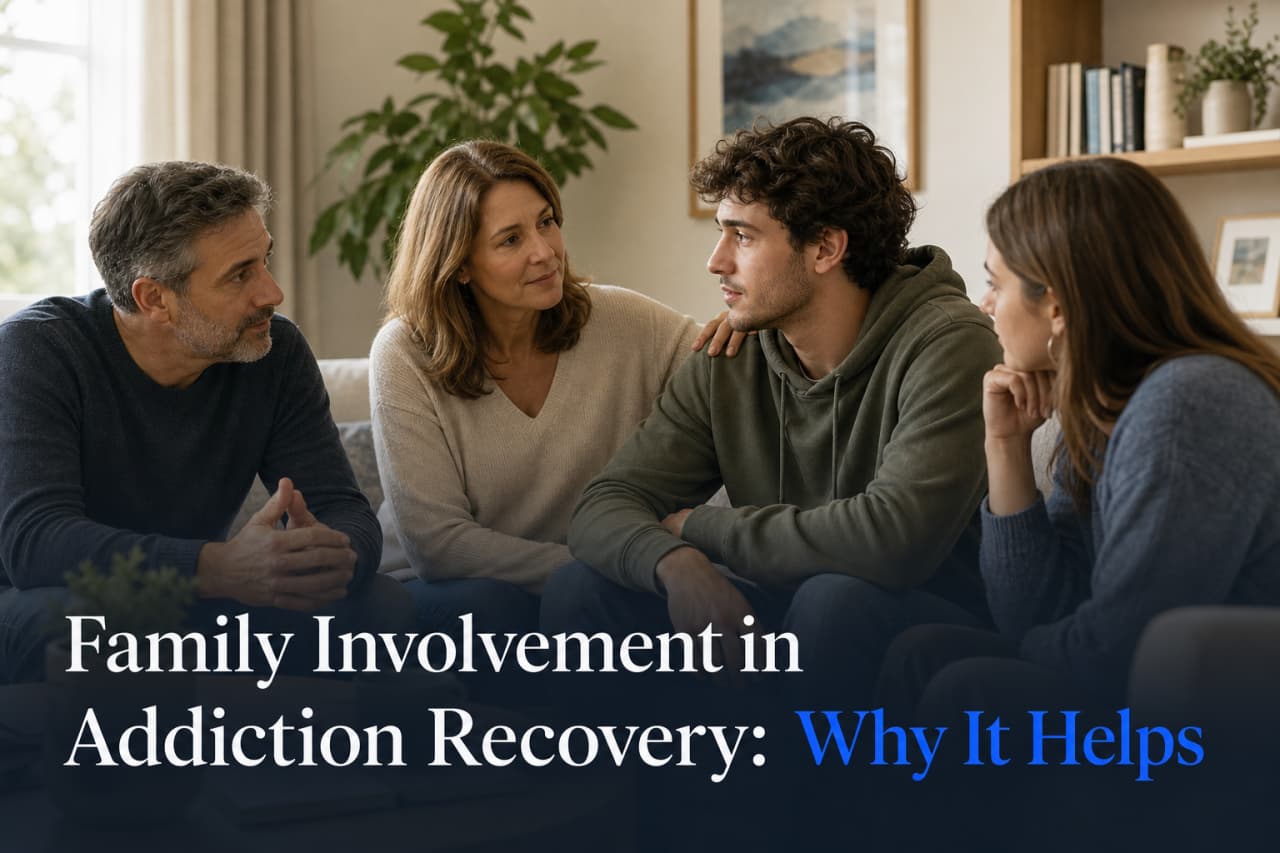
Secrecy, repeated questioning, mixed messages, crisis-only talks, and long stretches of silence show up in many households affected by substance use. These addiction family communication patterns keep attention on the next emergency instead of clear requests and limits. A pattern map helps you name the exchange, pick one replacement, and practice it with support.
What do addiction family communication patterns look like?
The clearest sign is repetition. Details shift, yet the family keeps having the same argument, making the same rescue, or avoiding the same subject. The Family Recovery Foundation’s Intensive Family Program starts with the definition of addiction before codependency, communication, and boundaries, so relatives share one frame for what they are seeing.
Use this map to identify the exchange rather than label a person. More than one pattern may appear in the same conversation.
| Pattern | What it may sound like | Possible function | Clearer replacement |
|---|---|---|---|
| Secrecy | I didn’t tell you because you’d be upset. | Avoids an immediate conflict | Set a specific time for a brief, factual conversation. |
| Repeated questioning | Where were you? Who was there? Why didn’t you answer? | Seeks certainty through monitoring | Ask one concrete question and state what you’ll do with the answer. |
| Crisis-only communication | The family talks only after a missed obligation, financial problem, or return to use. | Keeps attention on the latest emergency | Schedule a regular check-in before another crisis occurs. |
| Mixed messages | One relative sets a limit, and another quietly reverses it. | Reduces tension for a few hours | Discuss limits privately and give one consistent answer. |
| Covering and minimizing | A relative makes excuses, pays a debt, or hides what happened. | Prevents discomfort or outside consequences | State the facts without excuses and stop taking over the other person’s responsibility. |
| Silence | Everyone avoids the subject for days. | Delays an argument | Use one observation, one feeling, and one request. |
The labels apply to exchanges, not people. A family member may question repeatedly in one situation and go silent in another.
Name the loop first.
Why does substance use change what families say?
Uncertainty pushes talk toward monitoring and prediction. A person with a substance use disorder may hide use, location, spending, or symptoms. Relatives may check phones, ask the same question several ways, or hunt for signs that another problem is coming.
Conversations then sound like investigations. The person being questioned may grow defensive or disclose less. That response raises the family’s fear, which leads to more questioning. The loop feeds itself even when everyone wants a different result.
The National Institute on Drug Abuse explains how repeated substance use can affect brain systems involved in reward, stress, and self-control. A disease frame can sit beside accountability. Families can recognize the health condition and still set limits around money, safety, housing, and respectful speech.
The first two modules in our Intensive Family Program cover addiction and the central nervous system. Later modules address manipulation, enabling, gaslighting, and difficult conversations. That order helps you separate a health condition from the communication choices each family member still controls.
How can you map a repeated family conversation?
Map one exchange at a time. Trying to explain the entire family history usually pulls you back into blame. A recent conversation gives you words and actions you can actually review.
Record what happened. Write the time, the observable event, and the exact request, and leave out guesses about motives. Name the loop with a plain label such as repeated questioning, mixed messages, silence, covering, or crisis-only communication. Identify your part by marking what you said, did, paid for, hid, threatened, or repeated. Choose one replacement and write the sentence or action you will use when the pattern appears again. Review the result by asking whether you followed your plan, even if the other person’s response stayed the same.
For example, replace three late-night arguments about missed calls with one planned statement: “I was worried when I couldn’t reach you. I’m available to talk tomorrow at 10 a.m. I won’t discuss this while either of us is shouting.” The statement names an observation, offers a time, and sets a limit.
Modules 6 through 9 of our Intensive Family Program cover difficult conversations, boundaries, connective language, and gaslighting. Families can also use our Family Support Plan and Relapse Prevention Plan worksheets to put agreements and responses in writing.
A pattern map is an observation tool, not a diagnosis. Use it to track repeated exchanges and your own choices.
Which communication changes should you try first?
Start with one change you control. Replace repeated questions with a factual observation and one request. Long speeches create extra points to dispute. A short statement gives everyone a clear subject.
Try a compact structure. Observation: “You missed our agreed check-in last night.” Feeling: “I felt worried and angry.” Boundary: “I won’t lend money after a missed agreement.” Offer: “I can help you contact a treatment provider or attend a scheduled appointment.”
This structure keeps the talk tied to facts, feelings, and choices. It also cuts mind-reading lines such as “You don’t care about this family” and predictions such as “You’ll never change.”
Fix Your Family, our national signature program, teaches communication strategies, boundary-setting techniques, and conflict resolution skills. The free virtual session meets every Monday at 7:00 PM CT and 5:00 PM PT. Beth Durling, MS, CADCII, ICADC, leads the program.
One clear sentence beats five warnings.
What if a boundary causes more conflict?
Conflict after a boundary does not prove the boundary was wrong. Check whether the limit names an action you control, can be followed consistently, and addresses a real behavior.
A boundary might be, “If shouting starts, I’ll end the call and try again tomorrow.” A demand might require another person to change on command. Your boundary explains your response. It does not control theirs.
Avoid adding new threats during the argument. Repeat the limit once, follow it, and discuss changes later. If relatives disagree, they should talk privately before giving an answer about money, housing, transportation, or contact.
Our Intensive Family Program includes modules called “Boundaries: Who I Am and Who I Am Not” and “The Language of Connective Boundaries.” The Courage to Detach workshop meets on the last Wednesday of each month at 5:00 PM CT and 3:00 PM PT. It focuses on loving without enabling and protecting your wellbeing while supporting someone you care about.



Short can be kind.
How can outside support change the pattern?
A facilitator can pause a repeated exchange, help each person identify their part, and give the family a specific line to practice. That outside structure helps when every home conversation returns to the same accusation, defense, or silence.
The Family Recovery Foundation provides free virtual family therapy nationwide, with no insurance required for free programs. Our free virtual family therapy hub includes structured sessions and online family support groups. The Family Programming page lists current sessions, and our family education programs offer modules and worksheets you can use between meetings.
The Family Room meets every Friday at 10:00 AM CT and 8:00 AM PT. This open-format group gives relatives a place to share experiences and ask questions. Morning Meditation runs Monday through Friday for 15 minutes, and 1-on-1 family coaching is available by appointment.
Registered families can also use a private messaging group with our Clinical Director and trained peer support team. Messaging access is available 24/7 for ongoing guidance. Our organization has a Christian faith-based orientation and provides clinical and spiritual care.
Practice works better with feedback.
When does a communication problem need emergency care?
Immediate danger requires emergency help. Call 911 if someone faces a medical emergency, violence, an overdose, or another immediate threat. Call or text 988 for a suicide, mental health, or substance use crisis.
The Family Recovery Foundation provides ongoing free family support. Emergency response, residential treatment, and detox fall outside our services. Families who need treatment referrals can also use SAMHSA’s national help resources.
We do provide application-based financial aid for residential, outpatient, detox, and intervention services. For ongoing family therapy, coaching, education, or help with an aid application, call 888-964-8825. A real person answers every day.
A communication script cannot replace an emergency plan. Use 911 for immediate danger and 988 for a suicide, mental health, or substance use crisis.
Common Questions
Our free family programs are virtual, available nationwide, and require no insurance.
Can I change communication if my loved one is still using substances?
Yes. You can change your side of the exchange while your loved one is still using substances. You can ask one question instead of six, stop covering missed responsibilities, and state what you will do if a limit is crossed. Your change cannot guarantee a change from someone else.
Should we discuss suspected substance use immediately?
Choose an immediate conversation when safety is at risk. For other concerns, wait until you can state the facts calmly and the other person can take part. Avoid starting a major discussion during intoxication, active conflict, or a late-night crisis unless emergency action is needed.
Do I need insurance for virtual family therapy?
No insurance is required for The Family Recovery Foundation’s free virtual family therapy and online support programs. Registration is available to families nationwide.
Do these family programs provide residential addiction treatment?
Our programs focus on family therapy, support groups, coaching, and education. Residential treatment and detox are separate services. TFRF may provide financial aid for treatment or intervention through an application process.
What if relatives disagree about the boundary?
Discuss the disagreement away from the person affected by the limit. Each relative should state what they can follow consistently. Fix Your Family can help families practice a shared response without turning one relative into the messenger or enforcer.
How quickly should family communication change?
There is no guaranteed timeline. Track one repeated exchange and measure whether you followed your chosen response. Consistent practice gives you a clearer measure than waiting for every family member to agree or react well.
Get free virtual family therapy
Register for free nationwide online family therapy and support programs — no insurance required.
Choose Get Help to register with The Family Recovery Foundation, or call 888-964-8825. A real person answers every day.
About the Author
The Family Recovery Foundation
Editorial TeamEducational and program resources from The Family Recovery Foundation (EIN 87-4108362) — free virtual family therapy and support for families impacted by addiction and mental health. Charity Navigator: charitynavigator.org/ein/874108362.